I wanted to begin with wool. With its cloud-like fibres and natural warmth, it appears to offer obvious material potential. Yet in recent years, it has become increasingly overlooked, its quiet versatility eclipsed by the rise of synthetic technical fabrics and performance-driven outdoor wear.
Nevertheless, this almost forgotten fibre has shaped so much of my local Cornish history. Before delving deep into the materials of many other cultures, it felt right to first explore the ones on my doorstep. Having researched the world of wool during my masters, it felt like a good place to start.
NOT ALWAYS WHITE AND FLUFFY
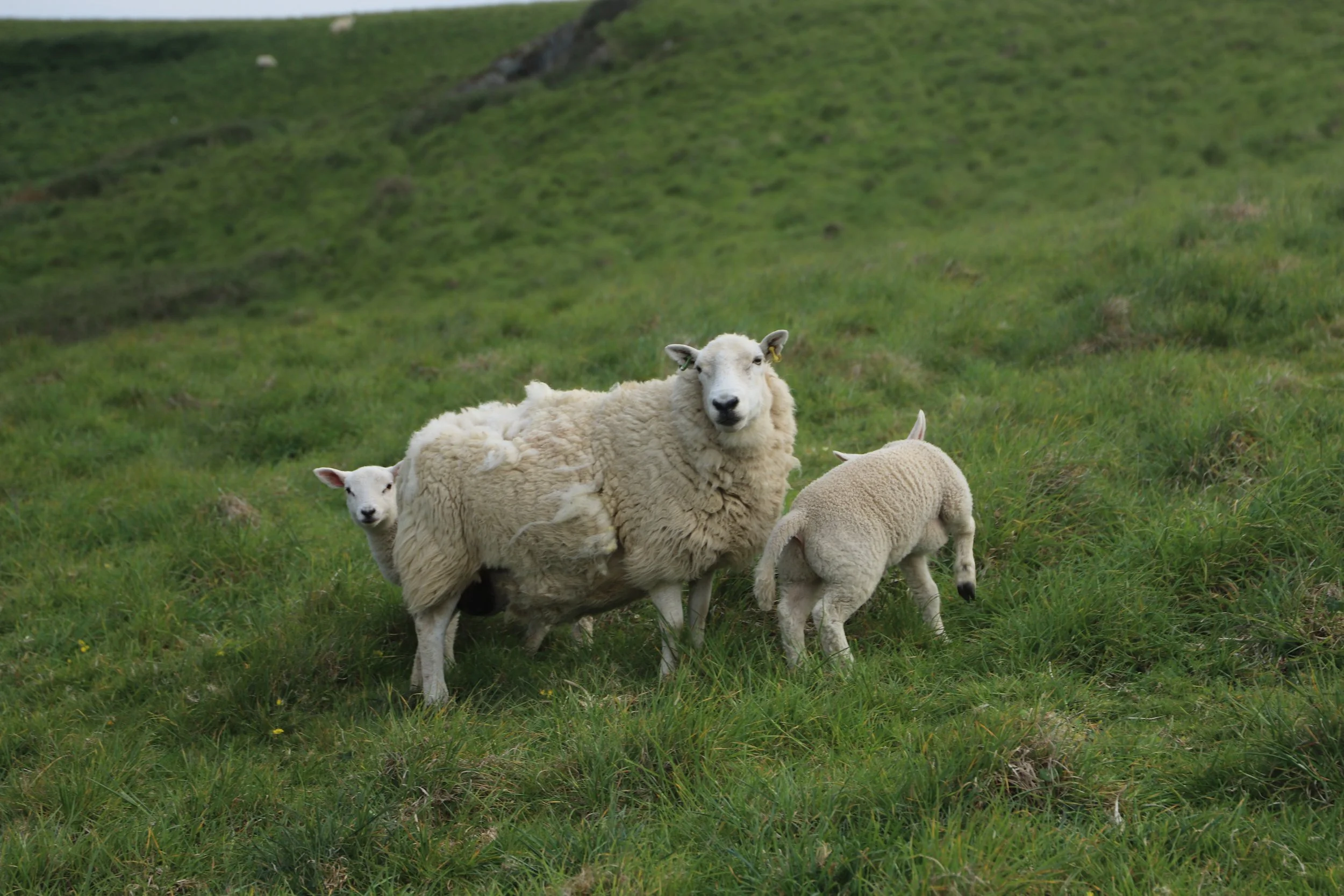
Modern wool is a descendant of the sheep’s wild ancestor, the Asian mouflon. Research suggests that through thousands of years of selective breeding (starting approx. 11,000 years ago in The Fertile Crescent), the mouflon gradually developed finer, denser and continuously growing fibres, losing its dark hairy outercoat (kemp), while retaining elements of its inner, insulating woolly undercoat.
STRING SKIRTS TO VIKING SAILS
The Egtved Girl, buried around 1370 BCE, is among the best-known examples of early woollen clothing. She was placed in an oak coffin beneath a peat bog burial mound in Denmark, wearing a woollen blouse and wool string skirt. The survival of her clothing offers a remarkable glimpse into Bronze Age textile production and dress nearly 3,400 years ago.
Wool’s historical significance extended well beyond clothing. In Viking Scandinavia, it was a resource that connected animal husbandry, women’s textile labour, technical skill, maritime trade and long-distance exploration.
In 1990, researchers examined the tattered remains of a woollen sailcloth discovered stuffed into a gap between the roof and walls of a 12th-century stone church in Trondenes, northern Norway. Dating to the mid-13th century, the fragments offered valuable evidence for understanding the construction of woollen sails and suggested the wool could have been treated with tallow and coloured with ochre, to help protect the fabric from the harsh marine elements. To appreciate the scale of such a cloth, a modern reconstruction of a 90 m² woollen sail for the Viking ship Ottar, used wool from as many as 200 sheep. Weaving the 157 metres of fabric took an estimated 7,850 hours—the equivalent of four and a half years of work for one person.
Wool might not immediately come to mind when considering Viking voyages, but without Nordic sheep and the women who spun their wool into sails, these ships wouldn’t have voyaged very far at all.
As is evident above, the diversity of sheep breeds that emerged through domestication gave wool an extraordinary range of properties and uses. In Britain, successive waves of settlers introduced various breeds including larger, white-faced, longwool sheep from the Mediterranean. These contributed to the development of Britain's longwool heritage, including breeds such as the Devon and Cornwall Longwool.
ADAPTED TO PLACE
Well suited to the South West's notoriously wet, windy and humid climate, the Devon and Cornwall Longwool produces a distinctive fleece of long, lustrous locks. Unlike the fine, dense fleece of a Merino, its wool grows in characteristic ringlets that cascade down the sheep's body. The structure of the fleece, together with the natural waxy coating of lanolin, helps it shed moisture and protects the fibres beneath. Its course, long fibres may be less suited to some fine apparel applications, but can be valuable in products that benefit from texture, durability, structure or insulation.
NATURE’S SMART TECH
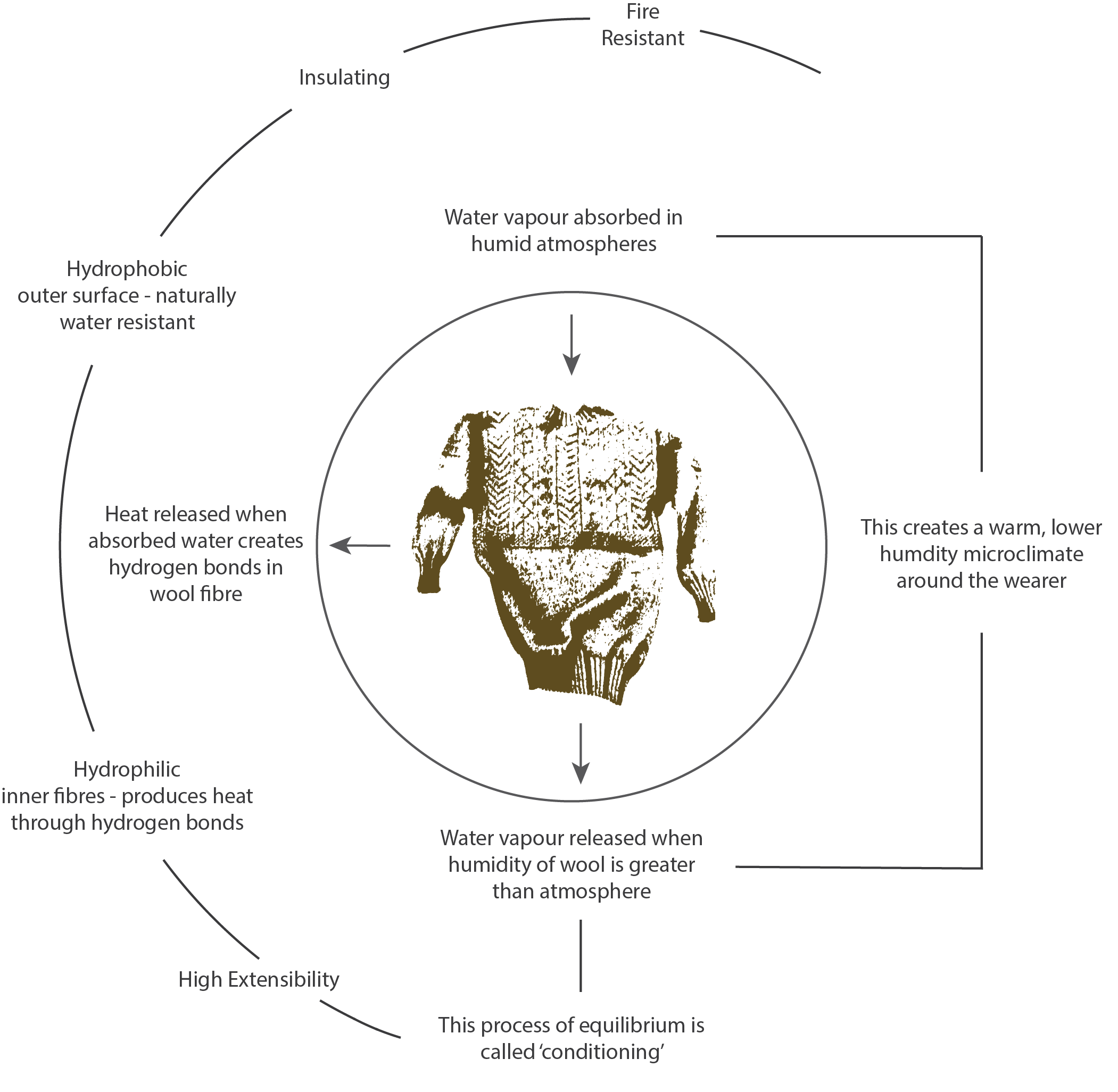
Wool's structure also gives it remarkable moisture-management and thermal properties. Water vapour is absorbed within the inner fibre’s hydrophilic keratin structure; a process which releases heat and allows it to absorb up to 30% of its weight in moisture without feeling wet. Not only does this make it naturally flame retardant, but it further creates a microbiome around the wearer that aids warmth and humidity regulation, in cold, damp conditions. It is little wonder that Cornish fishermen relied on woollen ganseys for generations.
NATIONAL TREASURE TO NEGLECTED RESOURCE
Once one of the most economically and politically valuable commodities in Europe, wool helped shape England's economy between the thirteenth and fifteenth centuries. Taxes on its trade helped fund the Crown, wars and major building projects. Today, the economics are very different: some British fleeces have so little commercial value that the return may not cover the cost of handling and transporting them. In some cases, farmers have resorted to burning or burying wool that is uneconomic to sell, highlighting the challenge of finding viable uses for lower-value British fleeces.
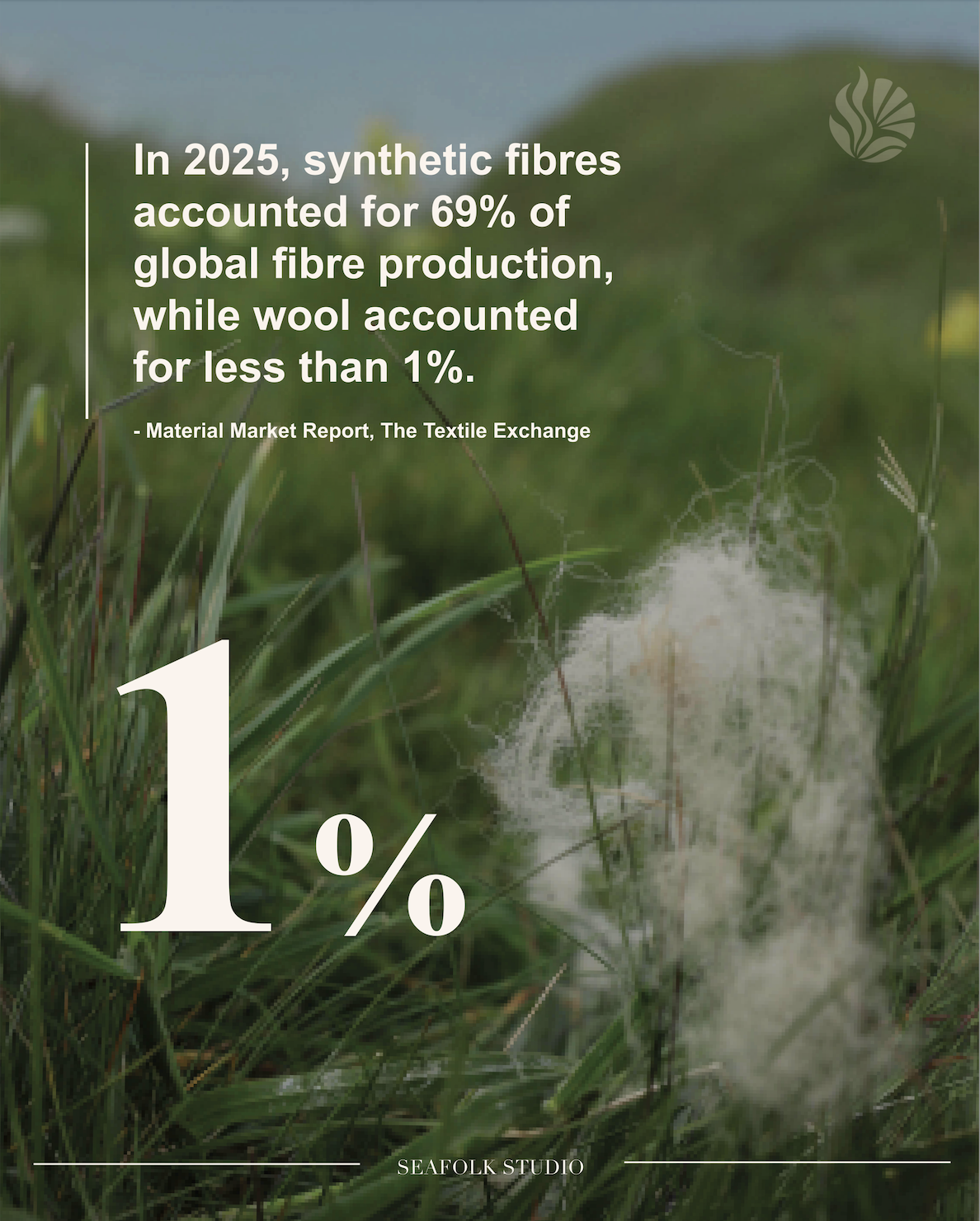
The UK government’s British Wool Review in 2022 reported that in 2020, synthetic fibres accounted for 62% of global fibre production, while wool accounted for less than 1%. The report also links the growth of synthetic fibres to declining returns for wool producers. The Textile Exchange’s more recent Material Market Report (2026) confirms that wool remains at 0.7% of the global fibre market whilst synthetic fibres had increased to 69% of global fibre production in 2025.
AN OPPORTUNITY FOR REGENERATION
Wool is not without environmental impact. Its footprint depends on how sheep are raised, how the fibre is processed, how long a product lasts and what happens to it at the end of its life. British Wool’s carbon-footprint research draws on data from 3,856 farms, providing a substantial evidence base for assessing the environmental impact of British wool across defined stages of its supply chain.
A new report done by DIRT charity and Oxford University’s Smith School of Enterprise and the Environment reveals that 528 million hectares of land across 73 countries are linked to wool, providing the fashion and textiles industries with one of the biggest opportunities to regenerate land. They state that properly managed grazing can support biodiversity, store carbon in soil and vegetation, protect soil from erosion and help rain soak into the land, instead of running off it. They go on to say
“In biodynamic farming, (sheep’s) manure returns to the land as fertility… The whole farm is treated as one living organism, guided by the rhythms of nature.”
In a 42-year Swiss DOK trial, biodynamic soils with higher manure input, built soil carbon.
The Textile Exchange’s Responsible Wool Standard (RWS) is one of many certifications emerging to verify wool products that have considered animal welfare, land management, labour and worker rights and clean supply chains. In the United Kingdom in 2025, only 0.47% of all wool produced was Responsible Wool Standard certified. Whilst Australia produced the largest amount of RWS wool by total weight in the world.
SOME FINAL THOUGHTS
Wool is a material shaped by thousands of years of human ingenuity, animal adaptation and local knowledge. From the sails that carried Viking ships across northern seas to the ganseys worn by Cornish fishermen, its value has always extended far beyond its ability to keep us warm. It is a fibre with remarkable properties, deeply rooted in the landscapes, cultures and communities that have worked with it. When responsibly sourced, designed for longevity and kept in use through repair and recycling, wool can contribute to a more circular and regenerative textile economy. The alarmingly little amount of wool in the overall global fibre production and the even smaller amount of RWS wool just shows how much more can be done with this amazing material, and what an opportunity that presents.
In Cornwall, wool carries centuries of knowledge about local landscapes, animal husbandry and making things that last. Reconnecting traditional knowledge with contemporary design could restore the value of this remarkable natural fibre and secure its place in the future of textiles.
FURTHER READING
BOOKS
1. Wayland Barber, E. (1994) Women’s Work; The first 20,000 years. New York: W. W. Norton & Company
JOURNALS + ARTICLES
2. Cooke, B., Christiansen, C. and Hammarlund, L. (2002) ‘Viking woollen square-sails and fabric cover factor’, International Journal of Nautical Archaeology, 31(2), pp. 202–210. Available at: https://doi.org/10.1006/ijna.2002.1039.
3. Gocho, H. and Nakajima, T. (1994) ‘Sorption behavior of water vapor on wool and descaled wool fibers’, Sen’i Gakkaishi, 50(7), pp. 321–324. Available at: https://doi.org/10.2115/fiber.50.7_321.
4. Jackson, N., Maddocks, I.G., Watts, J.E., Scobie, D., Mason, R.S., Gordon-Thomson, C., Stockwell, S. and Moore, G.P.M. (2020) ‘Evolution of the sheep coat: the impact of domestication on its structure and development’, Genetics Research, 102, e4. Available at: https://doi.org/10.1017/S0016672320000063.
5. Raven, M. (2022) ‘Wool smuggling from England’s eastern seaboard, c. 1337–45: An illicit economy in the late Middle Ages’, The Economic History Review, 75(4), pp. 1182–1213. Available at: https://doi.org/10.1111/ehr.13141.
MUSEUM + HERITAGE SOURCES
6. National Museum of Denmark (n.d.) ‘The Egtved Girl’. Available at: https://en.natmus.dk/historical-knowledge/denmark/prehistoric-period-until-1050-ad/the-bronze-age/the-egtved-girl/.
7. Oseberg Viking Heritage (n.d.) ‘A sheep in the sail’. Available at: https://osebergvikingarv.no/eng/the-oseberg-ship/the-oseberg-find-in-short/a-sheep-in-the-sail/.
8. Victoria and Albert Museum (n.d.) ‘Knitting traditions of the British Isles and Ireland’. Available at: https://www.vam.ac.uk/articles/british-knitting-traditions/.
9. Viking Ship Museum (n.d.) ‘The weaver’. Available at: https://www.vikingeskibsmuseet.dk/en/professions/education/all-about-the-viking-ship/skibets-haandvaerkere/vaeveren.
INDUSTRY + CONSERVATION ORGANISATIONS
10. British Wool (n.d.-a) British Sheep: Breed Book. Available at: https://shop.britishwool.org.uk/wp-content/uploads/2021/05/Breed-Book.pdf.
11. British Wool (n.d.-b) ‘Carbon Footprint of British Wool’. Available at: https://www.britishwool.org.uk/trade/wool-carbon-footprint-data/.
12. Rare Breeds Survival Trust (n.d.) ‘Devon and Cornwall Longwool’. Available at: https://www.rbst.org.uk/watchlist-breed/devon-cornwall-longwool/.
REPORTS + REVIEWS
13. Department for Environment, Food & Rural Affairs, Welsh Government, Scottish Government and Northern Ireland Executive (2023) British Wool Review 2022. Available at: https://www.gov.uk/government/publications/british-wool-review-2022/british-wool-review-2022.
14. Textile Exchange (2026) Materials Market Report 2026. Textile Exchange, 22 September. Available at: https://textileexchange.org/app/uploads/2026/09/2026-Materials-Market-Report.pdf
15. Cecil, C., Liu, M.S., Fankhauser, S., Muse, A. and Petzer, H. (2026) The Climate and Agricultural Impact of Textile Production. DIRT Charity and the Smith School of Enterprise and the Environment, University of Oxford. Available at: https://www.dirt.charity/oxford-x-dirt-report